
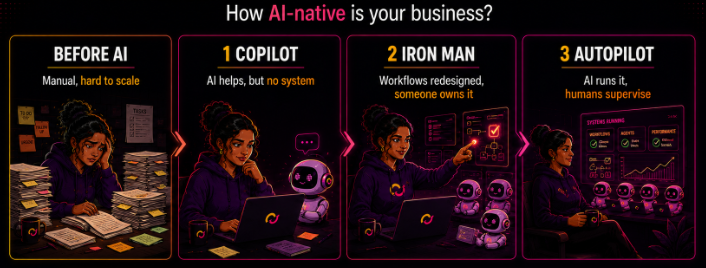
AI Is Easy to Start. Then What? 🤖
Most founders are somewhere between "we've tried something" and "we know we need to do more." The tools are not the hard part. Claude exists. ChatGPT exists. Vibe coding works. You can spin up a proof of concept in an afternoon.
The hard part is what happens after. The thing gets built. Nobody rolls it out. The team does not use it. The token bill arrives and the math stops making sense. Whoever built it leaves the company or gets pulled onto something else, and the workflow quietly stops working.
AI implementation is not primarily a technology problem. It's a people problem. Specifically, it is a question of who owns three distinct jobs, and what happens when one of them is missing.
The Suit, the Builder, and the Operator 🦾
An interesting way to think about AI implementation is to draw it from Iron Man.
Tony Stark has a suit. Sometimes he flies the suit. Sometimes the suit flies him. The point is that there are three distinct things: the suit itself, the person who built it, and the person who operates it. Each one is a different job.
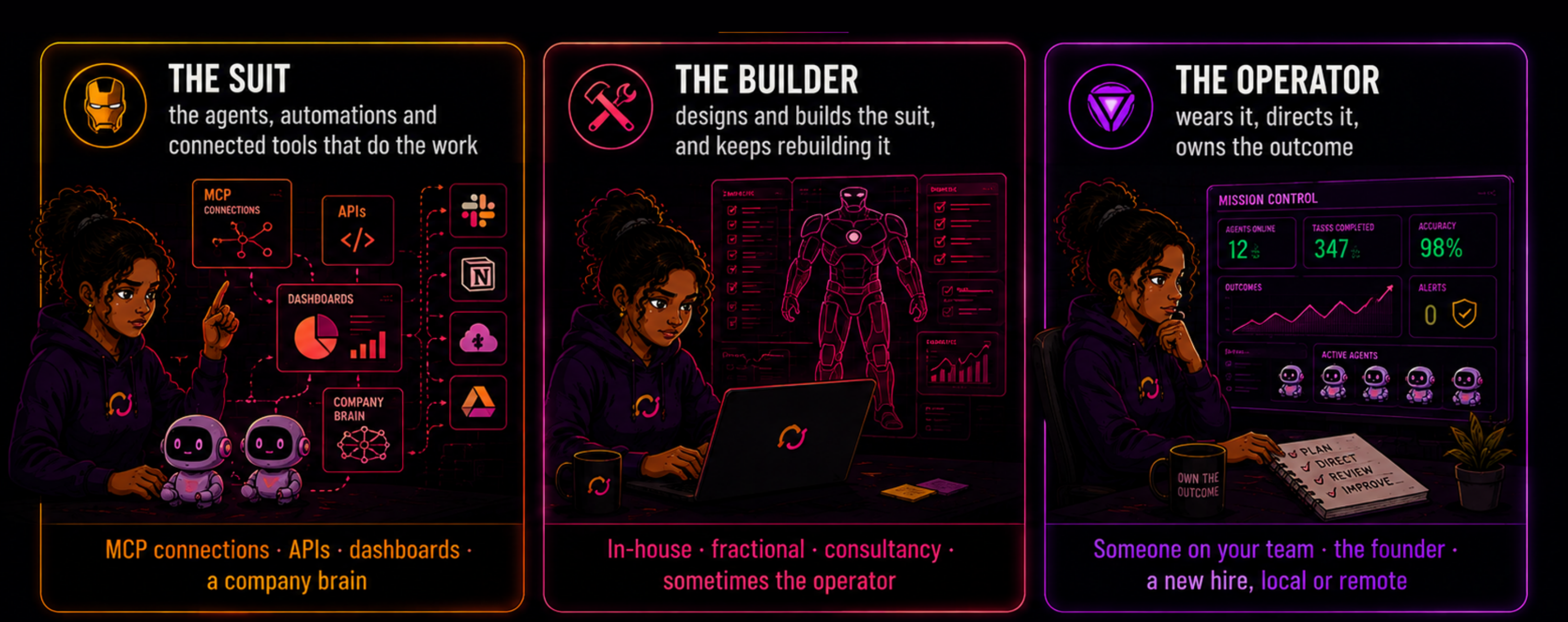
The suit is the automation infrastructure. The agents, the workflows, the tools wired together. It might be a single workflow or a system of them. It lives in your tools, runs on your data, and gets smarter as you use it.
The builder is the person who designs and constructs the suit. They map the workflows, connect the tools, write the logic, set up the evaluation so you know when something is wrong, and rebuild it when the models change. As the frontier models keep evolving, the suit needs to evolve with them. That is ongoing work, not a one-time project.
The operator is the person who wears the suit. They direct it, review the output, give feedback to keep improving it, and are accountable for the result. If an agent sends the wrong thing to your biggest client, your client is not going to accept that as AI's fault. Someone has to own it.
Most businesses have one of these. Some have two. Very few have all three. And when one is missing, the whole thing breaks down in a predictable way.
What Goes Wrong When One Is Missing ⚠️
No builder: Someone vibe-codes something impressive on a weekend. It works for a while. Then a model update changes the behavior, or an edge case breaks the logic, or a new tool makes the whole approach obsolete. Nobody is there to fix it. The system quietly stops being useful and everyone goes back to doing things manually.
No operator: The suit gets built by someone technical. It runs. But nobody is actually flying it. Nobody is reviewing the output, catching the errors, giving feedback to improve the system. One founder we spoke to this summer built an agent and was genuinely proud of it. Nobody on the team uses it. If the agent is built and no one is there to operate it, it does not make an impact.
No cost owner: This one catches a lot of people off guard. A workflow that was taking a team member 1.5 hours a day manually was rebuilt as an automated overnight process. Then the Claude bill arrived: $600 a month. The person doing it manually costs $700 a month full time. The math did not make sense, so the workflow was paused and rebuilt more efficiently. A survey of companies implementing agentic workflows found that 85% miss their AI cost forecasts by at least 50%. Agentic workflows burn five to thirty times more tokens than simple chat interactions. Someone has to be watching that.
If any of these sound familiar — a tool nobody opens, a spreadsheet still running the "automated" process by hand, a bill that made you wince last month — that's usually a missing role, not a broken idea.
How an Electrical Contractor Started 🔌📋
An Atlanta-based electrical contractor we worked with, roughly 15 to 20 people, had solid revenue and systems that worked. But growth still ran through two people — and that's the part that actually blocks a $5M business from becoming a $10M one. Fast, accurate service estimating existed, but only in one owner's head and his own ChatGPT history — when his attention moved elsewhere, estimates slowed or got missed, and that meant lost bids. Vendor invoice review caught things like equipment billed past its rental period or a weekly rental charged as a full month — but only because one person remembered the details of every job, which doesn't scale as volume grows.
.png)
The mapping found something more useful than a tool list: the business didn't have a lack-of-tools problem. It had a lack-of-a-system problem. The knowledge that made the business run was sitting in two people, not in anything the business itself owned. That's a different fix than "automate this task" — and it's the same thing that makes a business hard to sell down the line.
A few things stood out about what the actual work involved:
The core accounting system is old, and they didn't want to touch it. Their platform is decades-old and doesn't talk easily to other tools — but it's the one system the finance lead knows cold, and past attempts to switch platforms hadn't gone well. So the plan isn't to replace it. It's to build a layer on top that reads and writes to it where possible, and finds workarounds where it isn't — without asking anyone to change how they already work.
"Company brain" means connecting what already exists, not building something new. Information is scattered across email, shared drives, and the accounting system, with no way to search across all of it at once. The fix isn't a new piece of software — it's wiring the existing tools together so a question can actually get answered from one place, and so workflows can trigger automatically instead of depending on someone remembering to check three different systems.
Trust gets built in stages, not assumed on day one. The plan: the system drafts, a person reviews every output, and review time only shrinks once the drafts prove reliable — that's also how a team actually learns to work with something new, rather than being asked to trust it blind.
The real target wasn't efficiency — it was enterprise value. The owner's goal is to grow from around $5M to $10M over the next 5 to 6 years, then sell. That's a goal a lot of entrepreneurs share, whether or not they'd put it in those words: build something that keeps running without you personally holding it together. So the actual measure of success here isn't hours saved this quarter — it's whether the knowledge and the systems end up owned by the business instead of the people who happen to run it today.
What a Builder Actually Costs 💰
For context, here's roughly what this costs to staff. An AI Automation Specialist with 3-5 years of experience, at full-time offshore rates (40 hours a week):
- Most affordable (Nigeria, Pakistan, etc.): CAD $1,100 – $1,700/month
- Mid-range (Kenya, Philippines, India, etc.): CAD $1,600 – $2,500/month
- Higher-cost offshore (LATAM, Eastern Europe, South Africa, etc.): CAD $3,000+/month
If a full-time hire is more commitment than the work justifies right now, Fractional is the other path — a specialist working 10 hours a week, in two-week cycles, stop whenever. Either way, the starting point is knowing what you actually need built.
Three Questions Before You Build 📋
Before any AI project gets started, these are the three questions worth answering.
.png)
Who will build it? Not in the demo. In production. Who maintains it when the model updates? Who fixes it when an edge case breaks the logic?
Who will operate it? Who reviews the output, gives feedback, and is accountable for what it produces? That person needs domain expertise. They need to know when the AI is wrong.
What will it cost to run? Not to build. To run, month after month. Token spend, tool subscriptions, maintenance time. That number needs to make sense relative to the problem it is solving.
If you can answer all three, you're ready to build. If you can't, that gap — not the technology — is usually the whole problem. For most founders, once it's actually mapped out, it turns out to be smaller than it felt.
Suit, builder, operator. Answer who's doing each job, and you're not guessing anymore.
Goodwork is a Strategic Alliance Partner of EO Toronto.
We recruit and place offshore talent, run embedded fractional AI automation specialists, and support teams post-hire through our Accelerator training program (we're also official EOS licensees).
If any of this hit close to home, Goodwork's AI Roadmap is a one-hour session and a written plan in four days — what's worth automating, who should own it, what it'll cost to run.
Book a free consultation anytime if you want to talk through where you're at.